
Understanding Dilation and Effacement During Labor
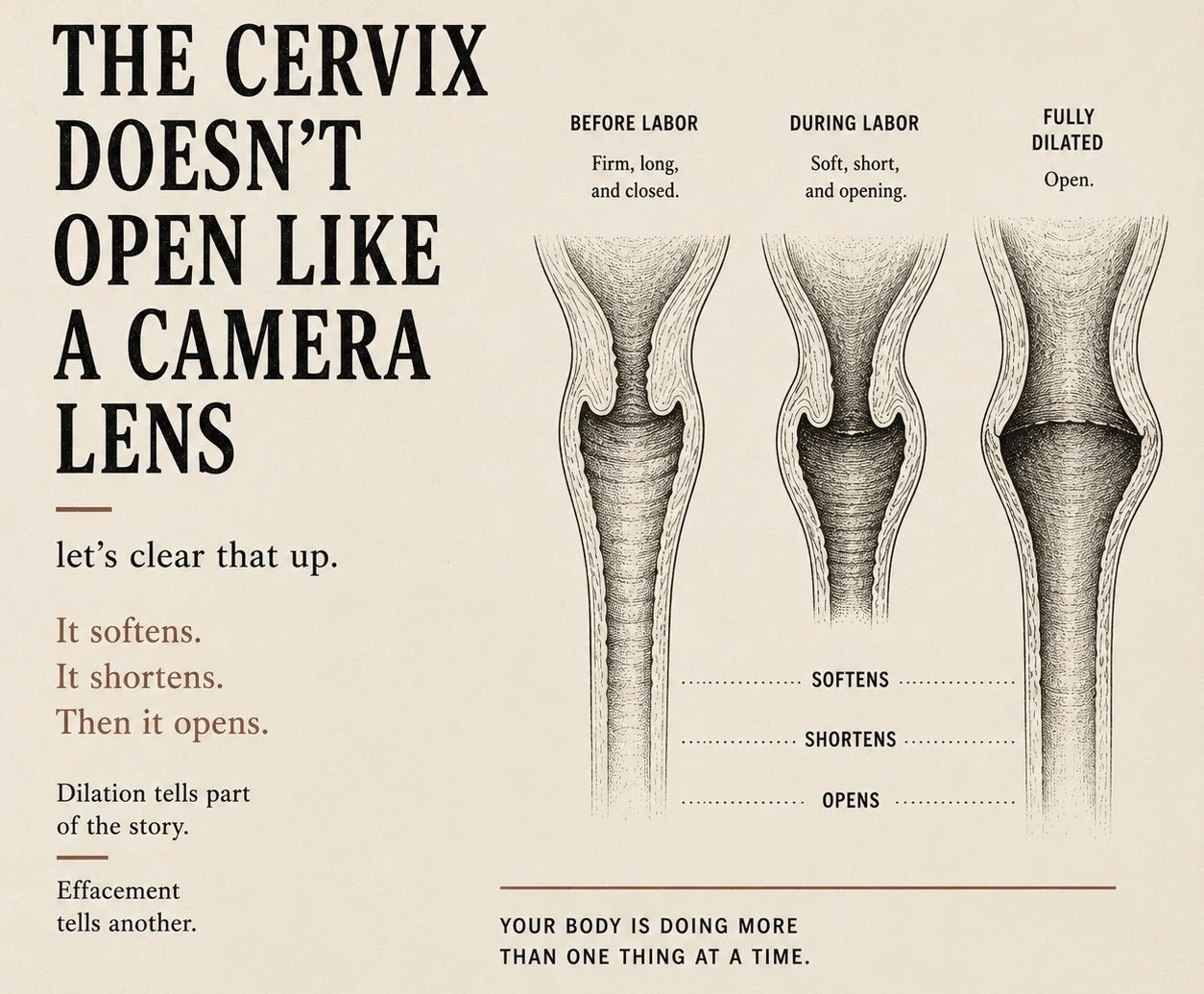
If you’ve ever taken a childbirth class, watched a birth video, or scrolled through social media, you’ve probably seen the cervix compared to a camera lens. It’s an easy visual. The cervix starts closed, then opens wider and wider until it’s fully dilated. Simple, right?Not exactly. While the camera lens comparison helps people imagine dilation, it leaves out a huge part of what the cervix is actually doing during labor.And understanding that difference can help labor make a lot more sense.
What People Imagine
Most people picture the cervix opening like this: Closed. A little open. Halfway open. Fully open. Like the aperture of a camera lens expanding outward. The problem is that the cervix doesn’t simply open. It changes in multiple ways at the same time.
What the Cervix Actually Does
During labor, the cervix has three major jobs:
1. It Softens
Before labor begins, the cervix is usually firm and thick. Many providers describe its texture as feeling similar to the tip of your nose. As labor approaches, hormones help the cervix become softer and more pliable. This process is sometimes called cervical ripening. A soft cervix is more able to stretch and respond to contractions.
2. It Shortens
The cervix isn’t just an opening. It’s a tube. During pregnancy, that tube is usually around 3 to 4 centimeters long. As labor progresses, the cervix gradually shortens and thins. This process is called effacement. You may hear measurements like:
50% effaced
80% effaced
100% effaced
These percentages describe how much the cervix has thinned and shortened.
3. It Opens
Only after the cervix begins softening and thinning does it fully open. This opening is called dilation. Dilation is measured in centimeters:
1 cm
3 cm
5 cm
8 cm
10 cm
Ten centimeters is considered fully dilated. This is the measurement most people are familiar with. But it’s only part of the story.
Dilation and Effacement Are Different Measurements
A person can be:
1 cm dilated and 50% effaced
2 cm dilated and 90% effaced
5 cm dilated and 100% effaced
These measurements describe different changes happening in the cervix. Think of it this way: Dilation tells us how wide the opening is. Effacement tells us how thin and shortened the cervix has become. Both matter. Both are signs that the body is preparing for birth.
Why This Matters
Many pregnant people become discouraged when they hear they are “only” 1 or 2 centimeters dilated. But dilation is not the only work happening.
Your body may be:
Softening the cervix
Thinning the cervix
Helping baby settle lower into the pelvis
Coordinating contractions
Preparing tissues for birth
A cervical exam captures only a small snapshot of a much larger process. Labor is not a race to 10 centimeters. It’s a series of physiological changes working together.
The Takeaway
The cervix doesn’t open like a camera lens. It softens. It shortens. It thins. And then it opens. Dilation tells part of the story. Effacement tells another. Your body is often doing far more work than a single number can capture. And that’s important to remember when you’re preparing for birth. Birth education isn’t about memorizing numbers. It’s about understanding what your body is doing and why. When we understand the process, we can often approach labor with more confidence and less fear.
Beyond the Threshold Birth Services provides evidence-based pregnancy, birth, postpartum, and lactation support for families throughout the Dallas-Fort Worth area.

What Does a Doula Do? Honoring World Doula Week
World Doula Week
As World Doula Week begins, I want to take a moment to answer a question many people still ask: What does a doula actually do?
The simplest answer is this: a doula provides non-medical support during pregnancy, birth, and the postpartum period.
But that definition, while accurate, barely captures the heart of the work.
A doula is a grounding presence during one of the most transformative seasons of a person’s life. We offer emotional support, practical guidance, education, encouragement, and comfort as families prepare for birth and move through it. Our role is not to replace doctors, midwives, or nurses. Instead, we complement clinical care by helping families feel informed, supported, and confident in their choices.
Depending on a family’s needs, doula support may include helping them prepare mentally and emotionally for labor, discussing birth preferences, practicing comfort measures, supporting communication around informed consent, encouraging partners in their role, and offering calm, steady reassurance throughout the process.
Doulas also help create continuity. Birth can sometimes feel fast-moving, clinical, or overwhelming. A doula helps bring another layer of care into the room, one centered on presence, trust, and support.
For many families, having a doula means having someone who helps them slow down, ask questions, breathe, feel grounded, and remember that their experience matters too.
At its core, doula work is about support, not control. It is about helping people feel seen, heard, and cared for as they cross an important threshold.
That is one reason World Doula Week matters so much. It is a chance to honor the work doulas do every day and to raise awareness about the value of compassionate, informed, people-centered support in the childbearing year.
Birth is more than a medical event. It is a life transition.
And no one should have to move through it without support.
If you are pregnant, planning for birth, or simply curious about how doula care might support your family, I’d love to connect.